Meme: Between tariffs ($2,500+), spiking gas prices ($740), food inflation ($300), and the end of Affordable Health Care Act (ACA) subsidies ($1,500), the Trump administration’s policies will cost the average American household an extra $5,040 in 2026.
Analysis: $5,040 is likely an underestimate
What’s Going On: On May 15, 2026, Bluesky user Tizzy Woman (@tizzywoman) shared a meme claiming that the Trump administration’s policies would cost American families an additional $5,040 in 2026:
Alongside the meme, the user wrote:
New data shows Trump will cost the average American family $5,000 MORE this year.
People are already struggling. We can’t afford Trump or Republicans.
#WeCantAffordTrump
That post was not accompanied by any visible citations for the figures and costs cited in the meme, and it wasn’t the first iteration of the meme.
On April 20, 2026, Rep. Teresa Leger Fernández shared the same meme on Instagram — in a post that also lacked citations for the costs listed:
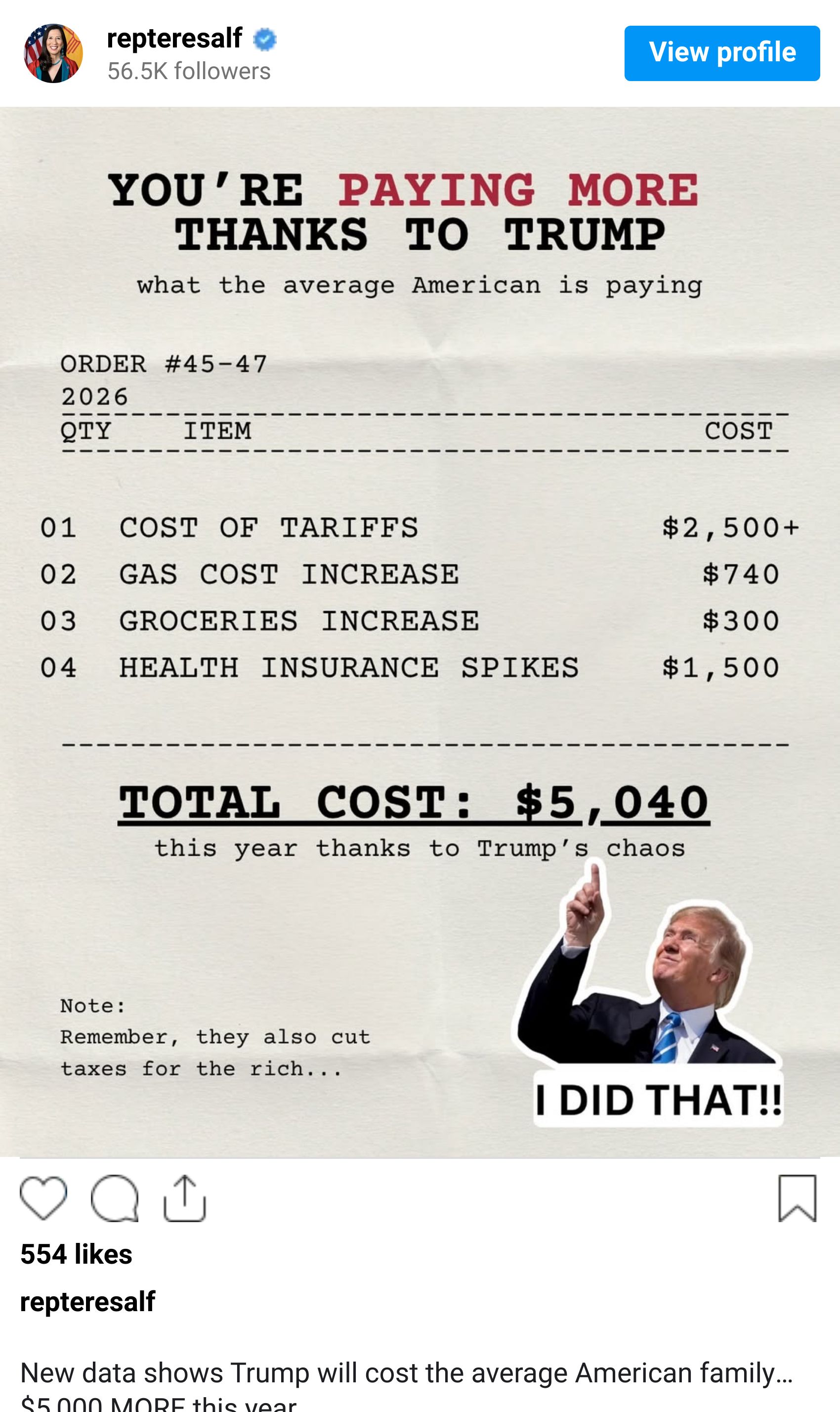
One questionable aspect of the meme was that the figures cited appeared to err significantly on the “low” side, as several Instagram commenters noted.
“I wish my health insurance was only up $1,500. It’s double that. Thanks, MAGA. I won’t forget,” a user replied.
“I don’t know how they’re calculating these numbers but I assure you it’s costing us more than an extra $300 this year in groceries. My monthly food costs have almost doubled. Think they need to talk to more people about the true cost increase,” another wrote.
“Yeah it’s way higher than what’s listed,” a third lamented.
As the meme contained four separate budgetary line items, we’ll look at them individually.
Is There Evidence That Tariffs Will Cost American Families over $2,500 in 2026?
This figure was initially hard to pin down, but it was referenced in a March 2026 Associated Press article.
Citing a contemporaneous report published by Democrats on the Congressional Joint Economic Committee, the AP reported:
Trump administration's import taxes will cost American households an average of $2,512 in 2026, up 44% from $1,745 in tariff costs in 2025
The claim that Trump administration tariffs would increase costs for the average American household by “over $2,500” appeared to originate with an official Congressional analysis, and was not plucked from thin air.
Notably, the JEC’s estimate that tariffs cost the average American household $1,745 in 2025 was lower than an estimate published by Yale’s Budget Lab in September 2025.
In those previous calculations, researchers likened the effect of tariffs on the average American household to the “equivalent of an average per household income loss of $2,400 in 2025.”
As such, that line item was substantiated.
Is There Evidence That Gas Price Increases Will Cost American Families $740 More on Average in 2026?
Off the bat, obtaining a solid estimate of the total, average cost of gas price increases in 2026 presented a problem — most of the year had yet to occur, and as the first quarter-and-a-half showed, energy costs are extremely volatile.
However, economists and researchers have attempted to predict a 2026 gas price trajectory, and to calculate the cumulative annual cost.
In a post updated on May 14, 2026, LendingTree noted that gas prices had skyrocketed 43.6% year-over-year to date.
The Institute on Taxation and Economic Policy (ITEP) — a non-partisan, tax-focused think tank — looked at state-by-state monthly gas price increases and estimated:
If gas prices remain elevated, the average additional cost for households will be several hundred dollars per year.
On March 25, 2026, Stanford University’s Institute for Economic Policy Research (SIEPR) published an in-depth analysis.
Once again, their findings outstripped the meme’s claim that the average household would spend $740 more on gas in 2026.
The researchers wrote:
Under the latest forecast, we project gas prices will peak at over $4.25 per gallon in May, and that the average household will pay $857 more for gasoline over the rest of the year.
In an April 9, 2026 press release, Sen. Ed Markey (D-IL) warned that “the average American family” would be subject to an “annual increase of $1,096 this year if gas prices remain at $4.14 per gallon.”
At press time (on May 15, 2026), the AAA’s Fuel Prices report placed the average cost per gallon of gas in the United States at $4.53 — down slightly from a yearly peak of $4.55:

Markey’s prognostication was predicated on a “high” of $4.14 a gallon in April; May’s high of $4.55 represented a 9.9% increase over the previous high.
As was the case with the previous line item, claims that American households were likely to pay an extra $740 for gas in 2026 was both substantiated and a conservative estimate when compared with calculations from researchers and subject matter experts.
Is There Evidence That Grocery Price Increases Will Cost American Families $300 More on Average in 2026?
Of the figures presented in the “$5,040 more in 2026” meme, the $300 grocery increase was one of two claims hotly contested by commenters.
Like fuel price volatility, determining average household cost increases for food was complicated — grocery shopping practices vary tremendously from one family to the next, even without factors like special or necessary dietary needs.
Moreover, record-keeping at key agencies like the USDA has changed tremendously, and the agency canceled its annual food insecurity survey in 2025 after three decades:

In other words, critical data on household food costs could — like the USDA’s household hunger tracking report — be incomplete or otherwise inaccurate in an effort to bury what is perceived as “bad news.”
Finding a credible 2026 grocery cost increase was further complicated by the differing rates of food inflation — staple items like coffee, chocolate, and beef have been subjected to steep incremental increases.
A February 2026 analysis from Money.com projected all meat would be 4.3% costlier in 2026 than 2025, with major categories like beef rising by 9.4% over the currently high cost.
We were unable to locate a firm, dollar-number projection for year-over-year grocery increases in 2026.
However, the Dave Ramsey-associated firm Ramsey Solutions estimated that the average monthly household grocery spend in 2025 was $6,053, with families of four paying between $1,002 and $1,631:
Household Size | 2025 Monthly Avg. Cost | 2025 Yearly Avg. Cost |
|---|---|---|
All | $504 | $6,053 |
Family of 4 (Low) | $1,002 | $12,024 |
Family of 4 (High) | $1,631 | $19,572 |
Assuming a household hewed to the budgetary average of 25% to 35% per trip for meat, that category alone would raise the three yearly averages above as follows:
Household Size | Monthly Increase (Meat) | Yearly Increase (Meat) |
|---|---|---|
All | $126-$176 | $1,512-$2,112 |
Family of 4 (Low) | $251-$351 | $3,012-$4,212 |
Family of 4 (High) | $408-$571 | $4,896-$6,852 |
Despite an absence of 2026 household grocery price increase estimates, the meme’s estimate that American households would spend an additional $300 annually at the supermarket appeared to be low based on meat costs alone.
This line item appeared to vastly underestimate grocery cost increases in 2026 based on current trends and data.
Is There Evidence That the Omnibus Bill’s Reversal of Health Insurance Subsidies Will Force American Families to Spend an Extra $1,500 in 2026?
Like with groceries, people commenting on the meme routinely decried the $1,500 figure cited as far too modest on its face.
Moreover, the complexity of America’s commercial health insurance model — and its status as the only developed nation that doesn’t guarantee health coverage to its citizens — made evaluating this particular figure exceptionally complicated.
However, organizations like the Kaiser Family Foundation (KFF) track and project healthcare cost increases based on industry data, providing useful, credible estimates.
In January 2026, the New York Times examined the impact of what is often called a “subsidy cliff,” with a notable observation in its subheading:
Earning just one dollar more could mean a $10,000 increase in insurance premiums.
Clearly, the Times was referencing a specific scenario — but in it, a $1 salary increase could raise a household’s annual healthcare premiums by $10,000.
That’s a far cry from $1,500.
The Times pegged the average annual cost of health insurance at $15,914, adding that individuals “who earn more than $62,600 — the people on the right side [of a chart] — get no subsidies at all. They pay full price.”
In September 2025, KFF analyzed the likely impact of the then-imminent loss of ACA subsidies in dollars, and their findings appeared to be the source of the JEC’s figures:

In the chart, the highest “Annual Dollar Increase” was $1,469, which matched the $1,500 in the meme. The lowest was $378.
It wasn’t glaringly obvious that KFF’s data had a toggle switch set to “individual” by default, whereas cost increases are typically considered in terms of households or a “family of four.”
KFF had a second table for households of four people, with substantively steeper cost increases in 2026:

Income levels differed on the second chart, ranging up to $130,000, or 404% of the Federal Poverty Level (FPL).
While the lowest “Dollar Increase” — for households making $40,000 or less — was $840, it leapt to $1,607 for families making over $45,000, $2,404 for families making over $55,000, and $3,368 for families making over $75,000.
The largest increase on the chart was for households making over $90,000, at $3,735 — and on the “individual” chart, income levels topped out at a modest $55,000 salary.
Through any lens, the JEC’s estimate that Trump administration policies would raise health insurance premiums by $1,500 a year for the average American appeared to originate with KFF’s analysis, but it lacked significant context (such as the “family of four” data).
There is a chance the meme factored in private insurance increases to arrive at that figure, but the alignment with KFF’s findings suggested the figure originated there.
Consequently, the $1,500 estimated increase for health insurance costs in 2026 appeared to be somewhat low, particularly given the gargantuan $3,735 increase for a household with a $90,000 income.
Is It Accurate to Say the Trump Administration’s Policies Will Cost Americans an Additional $5,040 in 2026?
In this case, the meme would be arguably more accurate with an “at least” qualifier, as in costs will rise by “at least $5,040” for the average household in 2026.
Markey’s higher estimate for gas prices, for instance, was based on an April 2026 high of $4.14, but gas prices hit $4.55 in early May 2026.
An Instagram user asserted that the real-world 2026 cost increases looked “way higher than what’s listed,” which related data appeared to reflect.